

In the third official installment of my ordinal and FV rankings of the Nationals system, it’s impossible not to compare this organization to where it stood a year ago. As I and others noted during Spring Training, the Nationals farm system was completely remade through the 2025 Draft, trade deadline, and offseason. With a third of the season complete, it’s also clear the new player development staff has gotten its claws into a number of players, several of whom have taken meaningful steps forward. If you’re interested in going straight to the list, feel free to skip the next section. If you are looking for commentary on a specific player, every ranked prospect above 40 FV has their own paragraph beginning with their name in bold. Players below that are sometimes grouped by their Mental Mapping category but still mentioned by name if you like Ctrl-F.
A Brand New Look
This list is meaningfully different and, I believe, a better product for Nationals fans. Here’s a quick primer for some of the columns:
FV: Future Value, popularized by the similarly titled book, is a prospect grading system built on the traditional 20–80 scouting scale, with “+” grades used to indicate unusual upside or proximity within a tier. Each FV tier will have an explanation of expectations in italics.
Position: While each player’s listed position generally reflects where they currently play, this category represents where I expect them to play at the major league level. A number of MIRPs could serve as swingmen or spot starters but I project them into the roles I believe they’d fill on a competitive playoff team.
Mental Mapping: When trying to sort through this many names, I grouped roughly 70 players by shared defining traits before breaking those categories into tiers. Rankings within FV tiers are less meaningful than the gaps between tiers, and these groups help create a clearer organizational structure.
Public Consensus: A month ago, I published a Consensus Board based on a number of public prospect outlets. While I discuss the methodology and limitations of these rankings within my piece, I think its presence can draw attention to where I am deviating from other outlets.
Trend: Another category that comes from my ranking process, I use flags on old lists to indicate where I feel I need to adjust a player. Think of “Surge” and “Slide” as up and down arrows indicating a player’s recent trend relative to my prior expectations.
ETA (Rule 5 Eligible): ETAs are manually adjusted off the December a player needs to be added to the 40-man, which is the year indicated in parentheses. Players whose ETAs are in bold either are already on the 40-man or need to be considered for addition before this December’s Rule 5 draft to ensure they remain with the organization.
Want to see an old list to see how far I’ve come?
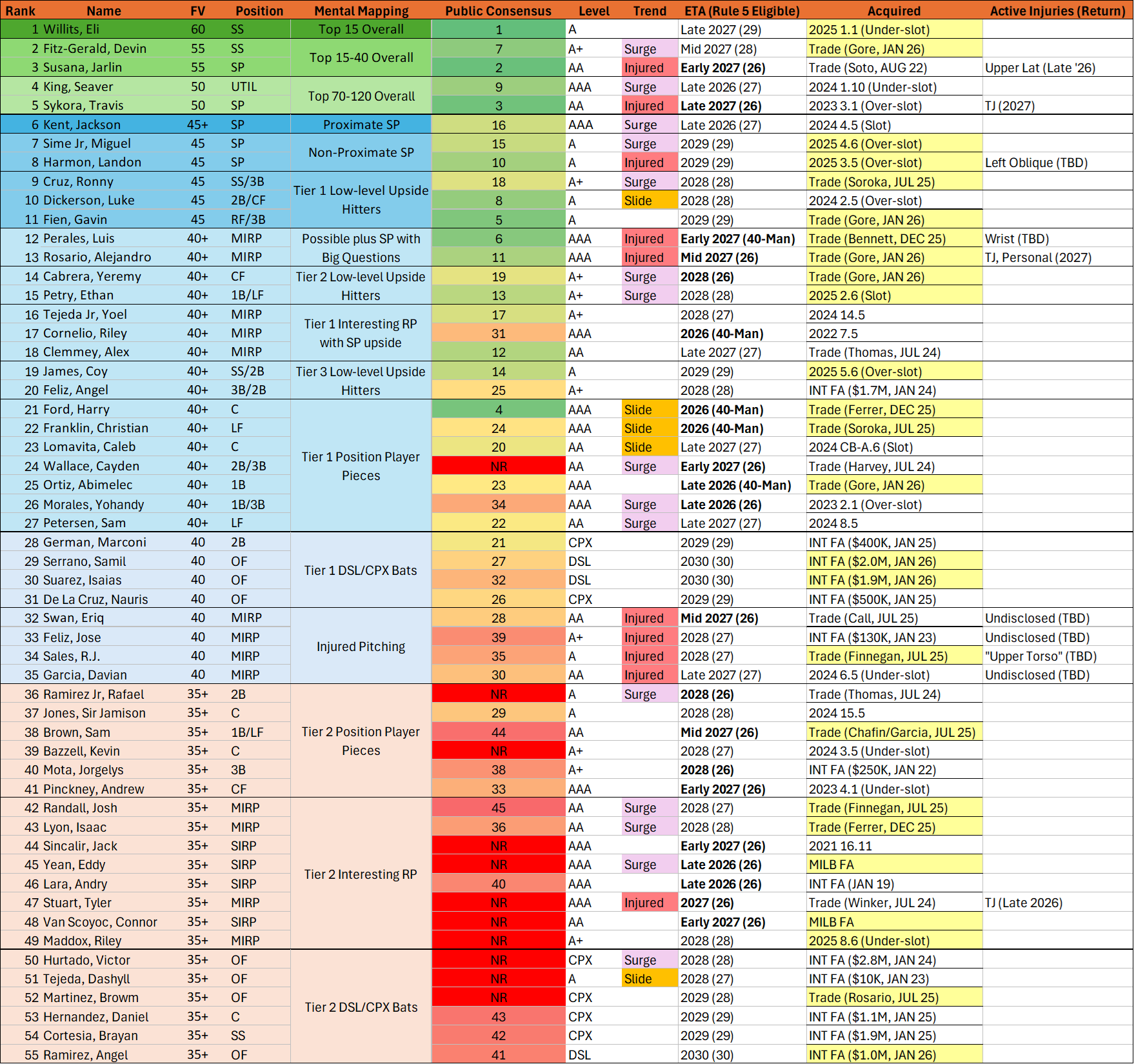
Washington Nationals Top 55 Minor League Prospects
System Overview
As I mentioned both in the lede and back in January, this is a remarkably different organization than it was a year ago. Five of the top 10 prospects, 10 of the top 15, and 16 of the top 30 have joined the organization within the last calendar year. Alongside the new faces, the organization’s minor league infrastructure underwent a significant overhaul this offseason, including several unconventional hires from public player-development labs and the collegiate ranks. While properly evaluating these changes will take years, the early returns have been promising.
There has been a clear organizational focus on developing speed, both in bat speed and pitch velocity. A number of hitters, Willits and King among them, have made meaningful bat-speed gains and seen corresponding spikes in power production, while several pitchers (Kent, Tejeda Jr., and Davian Garcia, for example) have shown increased velocity early in the season. These changes have been paired with approach changes, as Nats minor league batters are pulling the ball more and swinging less, while their pitchers continue to trend away from fastball utilization. It is clear the organization has shifted toward more analytically inclined development philosophies. Minor league wins are only a limited indicator of future organizational success, but it still feels notable that all four of the Nationals’ full-season affiliates are above .500. As a group, the organization finished last season with a combined .463 winning percentage and a -377 run differential. Things are different around here.
60 FV

Players within this tier are expected to compete for multiple All-Star appearances and rank among the top 15 prospects in baseball.
Eli Willits. While some were surprised by Willits’ selection first overall in 2025, I was enamored with his profile in the months leading up to the draft. A switch-hitting shortstop with elite bat-to-ball skills, Willits reclassified to enter the draft as a 17-year-old. Willits possessed many of the traits modern draft models value, while his under-slot bonus freed nearly $3 million for later picks. Early on, he has done well to dispel concerns that his bat-to-ball ability would lead to excessive chase rates à la Keibert Ruiz. His early 2026 numbers reflect a maturing hitter, pairing plus walk rates with above-average slugging while continuing to avoid swing-and-miss. Whether Willits reaches franchise-changing status will depend on how much power he grows into while maintaining plus defense at shortstop. Right now, Willits has evaluators dreaming on an early-career Francisco Lindor archetype: a dynamic leadoff hitter with sneaky power and plus defense at shortstop.
55 FV

Players within this tier are expected to be core pieces of competitive teams. They will typically rank between 15th and 40th on league-wide prospects lists.
Devin Fitz-Gerald. Less heralded than some of the other pieces in the Gore return, Fitz-Gerald possesses many of the same traits that made teams giddy over Willits. Another switch-hitting shortstop, Fitz-Gerald is walking as often as he strikes out while posting plus bat-to-ball metrics. Fitz-Gerald is a compact athlete with short levers whose swing looks noticeably smoother from the left side. The numbers support the visual evaluation, with a sizeable platoon split between his production against right- and left-handed pitching. Despite his smaller stature, Fitz-Gerald has exploded early this season while showing far more in-game power than expected. His raw exit velocities are closer to average, but he consistently pulls the ball in the air enough to access plus game power. Listed at 5’10” and 185 pounds, Fitz-Gerald still has room to add meaningful strength and improve his raw power, though additional bulk could eventually force him off shortstop. Fitz-Gerald is a smooth defender whose actions and arm would fit comfortably on the left side of the infield, though I ultimately expect a more dynamic athlete to push him off shortstop. At second or third base, Fitz-Gerald could resemble a smaller Ketel Marte: a hitter whose barrel control and hitterish traits would have old-school managers writing his name into the two-hole in pen every day.
Jarlin Susana. Susana recovered from a midseason Grade 1 UCL sprain and returned to Double-A before being shut down in September with a right lat tear, an injury that will likely delay the start of his 2026 season until late summer at the earliest. The fastball shape concerns are reminiscent of the conversations that surrounded Paul Skenes coming into his draft year. The pitch, which routinely sits above 100 mph and has topped 103, has enough velocity to still project as a plus-plus offering. His slider is elite, while his changeup began to stabilize as an average pitch with flashes of plus late in the 2026 season. As he matures, I think it’s likely the breaking ball evolves into two distinct shapes, though there’s already enough here to envision a Dylan Cease-style outcome in which he dominates primarily with two pitches. The walks will likely always be part of the profile, especially if his BB% settles closer to 15% than the roughly 10% mark he carried in Double-A. That will be one of the key indicators to monitor as he returns from injury. I used to think it was likely a different organization might have let him rip in the back end of a bullpen, but we’re talking about a guy who could be a Top-30 starting pitching in baseball by the 2027 playoffs.
50 FV

Players in this tier often rank within the top half of their position in the majors and appear towards the backend of public top 100 lists. At their peak, 50 FV players project to post multiple seasons between 2 and 3 fWAR and are rarely a target of replacement on a contending team.
Seaver King. King, one of the biggest beneficiaries of the organization’s revamped offensive approach, has cut his swing rate by nearly 10% while continuing to post above-average in-zone contact rates. While his strikeout rate has remained steady around 20%, his walk rate has jumped significantly, pushing his early-season OBP into the .400s. Despite still hitting too many ground balls, King has posted plus exit velocities and a hard-hit rate hovering near 40%. This represents a significant reversal in my evaluation, as I’ve gone from one of the lower evaluators on King to one of the most optimistic about his long-term outlook. Part of that shift comes from my belief that this staff is uniquely positioned to maximize King’s skill set. As King spends more time with this staff, its emphasis on swing decisions and pulled fly balls could allow his exceptional athleticism to translate at the major league level. King has struggled with consistency at shortstop, with defensive lapses reminiscent of CJ Abrams, but his small-school, multi-sport background leads me to believe there is still room for defensive growth as he enters his mid-to-late 20s. I expect King to see time throughout the infield, with enough speed and athleticism to slide into center field if needed. Fans hoping King pushes Abrams off shortstop defensively will likely be disappointed, but I still tend to bet on athletes of this caliber figuring it out.
Travis Sykora. Sykora has dominated at every stop in pro ball, posting an elite 36.7% K-BB rate across 45.1 innings while climbing to Double-A last season. At 6’6”, Sykora already possesses velocity and fastball shape, alongside a splitter and slider that both project as plus offerings. Despite his unconventional delivery and relative lack of experience, Sykora posted impressive walk rates and looks capable of developing plus command as well. He underwent Tommy John surgery last August and will miss most, if not all, of the 2026 season. This more conservative ranking is primarily a hedge against the uncertainty surrounding his recovery. If Sykora were healthy, I’d be comfortable ranking him similarly to pre-debut Trey Yesavage, whose fastball-slider-splitter combination during the 2025 playoffs offers a useful template for what an optimized version of Sykora could look like.
45+ FV

Players in this tier represent meaningful proximity and confidence or upside when compared to others in the 45 FV tier. Players in this tier are not always barriers to acquisition and free spending teams will sometimes invest in their replacements.
Jackson Kent. As one of the longtime high evaluators on Jackson Kent, I expect this ranking to surprise readers who have not followed him closely. While the goal of this piece is to provide updated evaluations, understanding Kent’s developmental path is essential to understanding why I rank him this highly. Here is an abridged version of what I wrote last August:
He’s had great underlying numbers this season, striking out a quarter of batters and running a 6.3% BB% across nearly 90 innings in High-A. He will likely eclipse 100 innings on the season. Kent is 22 years old, might be ready for 130+ innings next year, has four average usable pitches, and is limiting walks.
Then, this spring, I added the following:
His upside is likely limited to fourth-starter territory due to lack of a truly dominant pitch mix or elite command, but that is a player development win for a fourth-round pick. If he adds velocity, watch for him to pop in a big way.
Despite opening the season on the injured list, Kent has shown improved velocity, sitting around 95 mph early in outings while quickly climbing to Triple-A. His changeup is already a superlative offering, so much so that I worry he may lean on it too heavily against right-handed hitters at the expense of further curveball development. His delivery remains somewhat unorthodox, but Kent has continued to limit walks, posting a 6.6% walk rate early this season. If he can sustain this velocity, Kent is beginning to push into legitimate No. 3 starter territory and has positioned himself as the best healthy pitching prospect in the Nationals system. Kent could reach the major leagues shortly after the All-Star break and already looks capable of fitting into the Nationals’ rotation picture over the next several seasons.
45 FV

Good organizations are filled with players like this, who often play key roles on contenders. They are best utilized as contributors rather than centerpieces, filling the strong side of platoons, the back of rotations, and high-leverage relief roles. Some players in this tier possess elite upside, but enough questions remain to keep them below a 50 FV evaluation.
Miguel Sime Jr. Sime Jr. reminds me heavily of the version of Jarlin Susana I first evaluated in the year following the Juan Soto trade. Since his surprising promotion to full-season ball, he has been nearly untouchable. Sime Jr. throws incredibly hard, often sitting above 100 mph throughout outings that currently last only three or so innings. Across 19 2/3 innings since April 17, he has struck out a preposterous 50% of opposing hitters while also posting an equally absurd 17.9% walk rate. Despite its velocity, the fastball may only be his third-best offering, as a whiff-inducing gyro slider and hammer curve routinely leave hitters helpless in the batter’s box. Sime Jr. can look unhittable for an inning before completely losing the strike zone the next. Everything about Sime Jr.’s profile screams reliever: devastating stuff, a difficult-to-replicate delivery, and an inability to consistently find the strike zone. On the other hand, he’s still only 19, and, much like Susana in the second half of 2024, sometimes everything suddenly clicks for young pitchers with this kind of talent. Few pitchers in the minors possess Sime Jr.’s upside, and his development may become a defining test case for the organization’s new pitching infrastructure.
Landon Harmon. Harmon, who began the year in A-ball alongside Sime Jr., received a significant portion of the Nationals’ excess bonus pool from the under-slot Willits deal, effectively signing for late first-round money. Harmon looks every bit the part of a long-term starter. He has shown a natural ability to supinate and generate spin, sitting in the mid-90s with a fastball that features natural cut while also landing a plus vertical breaking ball for strikes. This is the type of skill that pitchers crave, and Harmon will likely have two plus breaking balls at maturity. His repertoire is reminiscent of early-career Corbin Burnes, whose cutter-breaking ball combination allowed him to generate strikeouts in bunches regardless of handedness. At a lanky 6’5”, Harmon already has a prototypical starter’s frame and still has room to grow into additional velocity as he adds strength. Harmon is still just 19 and is currently dealing with an left-oblique injury that landed him on the injured list, but he still appears on track to move quickly through the Nationals’ system once healthy.
Ronny Cruz. Cruz is a precocious rotator capable of generating truly impressive power for someone of his stature. His swing is a full production, featuring a high leg kick followed by an aggressive rotation designed to crush low and inside pitches to the pull-side. When everything is synced up, Cruz looks like a truly special hitter, but too often he appears to be guessing against more advanced breaking balls. Since his promotion to High-A, Cruz has chased nearly half the pitches he has seen outside the strike zone while also posting below-average in-zone contact rates. It’s an extremely volatile profile, capable of producing both explosive hot streaks and prolonged cold stretches. Cruz is a smooth defender, though his frame suggests he will likely move off shortstop sometime in his mid-20s. Either way, I expect him to remain on the infield dirt, where he still projects as a plus defender. Cruz has steadily climbed my rankings with each update, and this publication is no exception, but I remain hesitant until I see the offensive approach hold up over longer stretches against advanced pitching.
Luke Dickerson. I can’t quite quit Luke Dickerson, though this ranking represents a meaningful drop from his previous highs on my lists. Dickerson has been notably whiff-prone despite continuing to demonstrate strong swing decisions. He’s a compact, short-levered athlete, an archetype I generally favor, with explosive straight-line speed. His exit velocities remain comfortably plus, and his power has rebounded after dipping following a hit-by-pitch to the wrist last summer. Dickerson understands how to access his power and consistently pulls the ball in the air when he does make contact. More concerningly, in-zone whiff tends to be a far more difficult issue for player-development staffs to correct than chase tendencies. Dickerson has begun seeing time in the outfield this season, and he certainly possesses the speed to handle center field, though he currently lacks the instincts necessary to project as a plus defender there. On the infield dirt, Dickerson still looks capable of becoming a plus defender at either second or third base, though early hopes of his bat sticking at shortstop are beginning to fade. I still believe in Dickerson long term, which is reflected by his placement near the top of this talented cluster of lower-level Nationals infielders, but his star has faded a bit.
Gavin Fien. Fien was viewed by many as the headliner of the MacKenzie Gore trade, with some evaluators advocating for him as a top-five talent in the 2025 draft class. I think the most accurate description of his swing I’ve seen is Giancarlo Stanton with closer together feet, and it’s certainly not orthodox. His pre-draft performance on the summer circuit, often viewed as one of the strongest statistical indicators for high school hitters, was extremely impressive, but the strikeout concerns are significant enough to keep me from ranking him any higher. His performance against in-zone breaking balls is concerning, and more advanced pitchers would likely continue attacking him there until he proves he can punish it consistently. Even so, Fien punishes fastballs with authority and has already shown the ability to access plus pull-side game power. Those concerns would be easier to stomach if Fien still projected to remain in the infield. Instead, Fien has spent most of his time in right field this season, though he has recently begun seeing occasional reps in center field. I do not think Fien possesses the range to handle center field consistently, though his plus arm should allow him to profile as an above-average defender in right field. In right field, the offensive burden on Fien’s bat becomes significantly heavier, and he remains a potential candidate for a swing adjustment if the contact issues persist.
40+ FV
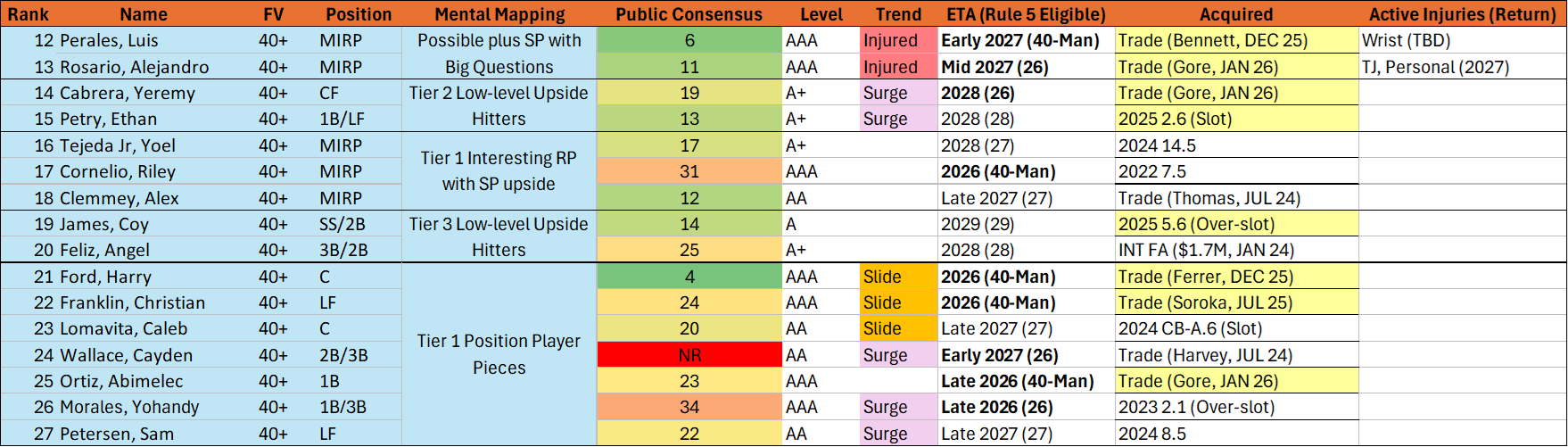
These are generally either (1) likely reliever-only pitchers or (2) prospects whose lack of proximity or developmental risk keeps them from a higher tier. I expect most of these players to reach and stick in the majors, though primarily in complementary roster roles.
Luis Perales. Perales has shown elite raw stuff, so much so that back in March I argued his fastball would immediately rival the best on the major league staff outside of Cade Cavalli. Unfortunately, Perales still struggles both to consistently throw strikes and to sequence hitters effectively enough to maximize his swing-and-miss ability. He relies on his four-seamer and cutter nearly 70% of the time, and the cutter in particular has been punished this season. His four-seam fastball features elite shape and plus velocity, though the lack of a reliable breaking ball currently prevents it from fully playing to its traits. Perales’ changeup has performed well enough that he actually posts reverse splits. He still struggles to consistently put away right-handed hitters, and I wonder whether reshaping his breaking ball into something closer to a sweeper could help address that issue. While Perales’ upside remains tantalizing, those limitations currently leave him looking more like a bullpen arm than a long-term starter. Just prior to this list’s publication, Perales took a comebacker off the wrist and landed on the injured list. Ironically, an extended recovery timeline could give Perales an opportunity to further refine his repertoire in ways that better support a future in the rotation.
Alejandro Rosario. Rosario could arguably belong alongside the injured pitchers at the top of this list after flashing truly elite upside in 2024. Much of Rosario’s report reads similarly to Sykora’s: dominant K-BB numbers, a plus fastball-slider-splitter combination, and significant questions surrounding the injury recovery timeline. His delivery appears more repeatable than Sykora’s, and his vertical release characteristics allow the fastball to play especially well at the top of the zone. At the conclusion of the 2024 season, it felt like only a matter of time before Rosario emerged as one of the top five pitching prospects in baseball. Unfortunately, Rosario never pitched in 2025 because of an undisclosed personal health issue before undergoing Tommy John surgery this spring, sidelining him until 2027. When he returns in 2027, Rosario will be 25 years old, Rule 5 eligible, and still sitting on just 88.1 professional innings, all of which came below Double-A. This is an incredibly difficult profile to evaluate because, on pure talent alone, Rosario might still profile as a top-20 prospect in baseball. At the same time, the Rangers were willing to move him as part of a five-player package in which he was not even the clear headliner.
Yeremy Cabrera. Cabrera, the fourth player from the MacKenzie Gore trade to appear on this list, also saw his red-hot start in A-ball cool following a promotion to High-A Wilmington. Cabrera clearly understands modern hitting philosophy, and his swing is aggressively designed to generate lifted contact to the pull side. His dominance in A-ball was fueled in part by a vicious 30% PullAir% alongside dramatically improved chase rates. Despite maintaining a nearly identical in-zone contact rate following the promotion, Cabrera’s chase rate has climbed back to an unpalatable 35%, driving increases in both swing-and-miss and strikeouts. Cabrera struggles against breaking balls and, like several players on this list, has run into trouble against more advanced pitchers capable of consistently locating them within the strike zone. Cabrera not only looks capable of handling center field, but could ultimately profile as a plus defender there. Right now, this looks like the profile of an interesting power-over-hit fourth or fifth outfielder, though solving the breaking-ball issue could allow Cabrera to develop into something more substantial.
Ethan Petry. Petry, a right-handed-hitting first baseman, projects to possess the bat necessary to clear the extremely high offensive bar associated with that profile. Petry absolutely demolished the Cape before his draft year, launching 11 home runs while posting a 1.235 OPS across 32 games. Petry’s ISO declined each season after his monster freshman year at South Carolina, though he also trimmed his strikeout rate to 17% during his draft season before suffering a shoulder injury. This season, Petry has paired a reduced strikeout rate with his trademark all-fields power, continuing to punish mistakes left over the plate. While his raw power is comfortably plus-plus, lingering whiff concerns could limit how consistently that power translates against advanced pitching. Petry has also seen time in the corner outfield, where he has looked surprisingly capable, even if somewhat range-limited. If he moves quickly enough through the minors, it is possible Petry debuts with some corner-outfield versatility, though he will likely settle in as a first baseman by his late 20s.
Yoel Tejeda Jr. Tejeda Jr. is a massive extender who has already demonstrated meaningful mechanical improvements since being drafted, to the point that his control is beginning to approach plus. If you are searching for breakout pitching prospects, Tejeda Jr. checks many of the same boxes Jackson Kent checked last fall: innings floor, a diverse pitch mix, and a starter’s frame. Tejeda worked sparingly out of the bullpen at Florida and Florida State, making him a likely slower-burn developmental arm as he builds innings and experience. After a velocity dip in 2025, Tejeda has regained mid-90s velocity this season, resembling the version of himself seen out of the bullpen in college. This ranking requires a significant amount of projection, but it is difficult not to be encouraged by the progress Tejeda has made since transitioning to pro ball. Tejeda Jr. would be a priority target for me if I were scouting for another organization.
Riley Cornelio. Cornelio, a somewhat surprising addition to the 40-man roster last offseason, sat around 97 mph in spring training, roughly two ticks higher than he averaged as a starter in 2025. That velocity has since settled closer to 95 mph, though his four-seam fastball still features significant horizontal movement. His lack of a true off-speed pitch has allowed hitters to sit on the fastball and punish mistakes. Cornelio features a gyro slider. It is not especially well regarded by public stuff models, but it generated a 50% whiff rate in Triple-A last season and is running closer to 60% this year. He has also experimented with a splitter that flashes plus potential, though it still misses arm-side and up too frequently to consistently function as a weapon. Cornelio likely needs to find a consistent off-speed option and better command to stick in a rotation, and developing both could eat heavily into his remaining option years. More likely, he settles into a multi-inning bullpen role where he can be deployed more selectively against right-handed hitters while potentially climbing back into the upper 90s in shorter bursts.
Alex Clemmey. Clemmey posted elite strikeout rates (>30%) in High-A before making the jump to Double-A, driven largely by a rising fastball and inconsistent breaking ball. As a teenager, Clemmey’s 6’6”, 205-pound frame convinced scouts his velocity would eventually climb into the upper 90s. Instead, three years into pro ball, his four-seam fastball still sits 93–95 mph, though it features enough ride to play at the top of the zone. His gyro slider can generate real swing-and-miss, and his changeup has taken a step forward this season, though he still occasionally loses feel for it entirely. Clemmey has time on his side: he is just 20 years old, already in Double-A, and will not be Rule 5 eligible until December 2027. I expect the Nationals to continue developing him as a starter, though his lack of a truly dominant offering and elevated walk rates likely cap him as a back-end rotation arm. Long term, he may ultimately fit better in the bullpen, where a few extra ticks of velocity could turn him into an intriguing leverage reliever.
Coy James. James was another high school draftee who received a significant bonus ($2.5 million, close to Comp A slot value) following the under-slot Willits deal. James is a flashy athlete with real speed and power potential, along with the defensive ability to remain on the left side of the infield. The upside is difficult to ignore, but James has struggled against breaking balls early in pro ball following his aggressive assignment to full-season ball to open the season. James remains one of the toolsiest players in the crowded lower-level Nationals infield mix and is a strong candidate to climb this list quickly as he gains experience.
Angel Feliz. Feliz struggled somewhat in his first exposure to full-season ball following a breakout 2024 campaign. He posted strong numbers (10.8% BB%, 18.6% K%, 129 wRC+) in the DSL in 2024 and opened 2025 in the CPX with similar underlying performance, albeit with slightly less power. Feliz hit ground balls at nearly a 50% clip last season, and his pull rates have declined significantly since moving beyond the DSL. Because he increasingly looks likely to move off shortstop, the power will need to develop for him to maintain a 40+ FV projection. Feliz’s aggressive promotion to High-A as a teenager is notable and suggests the organization remains undeterred by the current lack of power production. Right now, Feliz projects as a multi-positional bench bat, though there is enough feel for contact and approach here for him to become a high-IQ bottom-of-the-order hitter if he begins elevating and pulling the ball more consistently.
Harry Ford. Ford, acquired from Seattle in the Ferrer trade, only became expendable because he was blocked by the best catcher in baseball. No such obstacle exists in Washington. Ford possesses a somewhat nontraditional, OBP-driven offensive profile. He is a strong athlete, to the point that Seattle discussed transitioning him to left field in order to get his bat into the major league lineup more quickly. Ford has struggled this season, with nearly every aspect of his offensive profile regressing. His exit velocities are down nearly five mph, and he is chasing and whiffing far more frequently. I still expect Ford’s bat to rebound enough to clear the offensive bar for the catching position, though consistently above-average offensive production feels increasingly unlikely. Anecdotally, the Nationals have had early success improving catchers defensively at the major league level, with Keibert Ruiz and Drew Millas both grading positively as framers. While Ford has never been a poor defender, continued offensive regression would place increasing pressure on his glove to develop into true starter quality.
Christian Franklin. Franklin is another one of my favorite players on this list whom I am reluctantly dropping in this update. Franklin hits the ball extremely hard, posting hard-hit rates above 50%, but too much of that contact comes on the ground or to the opposite field. His average launch angle has declined even further this season while his ground-ball rate has climbed above 60%. Franklin is patient, rarely chases or whiffs, and gets on base at an above-average clip. He projects as an above-average defender in a corner and could handle enough center field to function as a quality fourth outfielder. Franklin would likely fit best on the short side of a platoon, where he could more consistently access his pull-side power. If Franklin were 22, this profile would rank near the top of the system, but at 26 his years of club control now extend well into his 30s. With the Nationals’ crowded outfield picture, Franklin feels like a player who could get lost in the shuffle here instead of carving out significant playing time for a more outfield-needy organization.
Caleb Lomavita. Lomavita shares many of the same traits as Seaver King, fitting given he was selected just 29 picks later in the same draft. He hits the ball hard, but too often on the ground, swings and chases excessively, and inconsistently applies his elite athleticism at a premium position. Lomavita generates above-average raw power with an aggressive lower-half operation, though he often overcommits against breaking balls out of the zone. He has shown an above-average ability to make in-zone contact, and his hard-hit rates have remained consistently strong. He has also shown an ability to pull the ball with authority, though too much of that contact still comes on the ground. Defensively, Lomavita has struggled more than early evaluations suggested. He has frequently struggled with throwing accuracy to second base, routinely sailing or skipping balls into the outfield, and opposing baserunners have consistently taken advantage. As mentioned earlier, the new development staff has shown an ability to improve catcher defense, which leaves room for optimism here. Lomavita remains athletic behind the plate, and the new staff may be able to unlock meaningful defensive gains. Right now, Lomavita projects more as a tooled-up backup catcher, though the ceiling remains the stronger half of a productive catching timeshare.
Cayden Wallace. Wallace, acquired in the Hunter Harvey trade that also brought over the Comp A pick used on Caleb Lomavita, has reemerged this season after a difficult start to his Nationals tenure. He possesses slightly above-average raw power and has cut his strikeout rate by nearly 8% year over year. Wallace is making more contact this season, both in and out of the zone, while doing a better job punishing pitches to the pull side. His bat is likely a bit light for an everyday third baseman, but he has begun seeing time at second base this season and increasingly looks suited for a utility role. While he has seen some time at shortstop following King’s promotion to Triple-A, I think it is unlikely he handles the position consistently in the majors. Wallace likely has enough athleticism to handle corner-outfield work as well, and additional versatility there would only strengthen his profile. Wallace profiles as a fringe Rule 5 candidate entering the offseason and could become a late 40-man roster addition if the organization views him as a viable major league depth piece.
Abimelec Ortiz. Ortiz is a stout left-handed-hitting first baseman capable of absolutely punishing the ball in the air to the pull side. His max exit velocity in Triple-A this season would tie James Wood for seventh in the majors, while his average exit velocity on fly balls and line drives would rank around 20th. Ortiz pulls the ball in the air more than 25% of the time and appears primed to translate his raw power into game production. Like many hitters with this kind of power, Ortiz chases too often and swings through too many pitches in the zone. His swing decisions have kept his walk rates below average, and he currently looks headed toward low-OBP seasons even at his offensive peak. Ortiz is defensively limited to first base, which raises the offensive bar to a difficult level for him to clear consistently. I think Ortiz could become the strong side of a first-base platoon, though he will likely need to improve his on-base ability to earn significant playing time.
Yohandy Morales. Morales is another bounce-back corner infielder whose Triple-A surface stats might leave some wondering why he is not ranked higher. Morales has always hit the ball hard, and this season has been no exception, as he continues to post elite hard-hit rates and exit velocities. He has increased his pull rate this season, but nearly three-fourths of the balls he hits to the pull side still come on the ground. Morales is often late getting to fastballs and remains prone to both chase and swing-and-miss. His in-zone contact rate hovers around a concerning 75%, a range where even truly elite power hitters struggle to survive offensively. While Morales still profiles best at first base, I have been pleasantly surprised by how sure-handed he has looked at third. I do not believe he will ever become an above-average defender at the hot corner, but I increasingly think he could occasionally spell a left-handed-hitting third baseman to gain the platoon advantage. For a team willing to play Curtis Mead at third base, I wonder whether it might be better served defensively by turning to Morales and allowing Mead to slide back into a more comfortable role.
Sam Petersen. Sometimes you just have to shrug and admit that good hitters keep hitting. Since his sophomore year of college in 2023, Petersen has posted full-season wRC+ marks of 139, 142, 165 (A/A+), and 130 (Double-A). I was initially hesitant on Petersen. Prior to Double-A, Petersen routinely faced younger pitching and generally performed the way you would expect an advanced college hitter to perform against inferior competition. This season, Petersen’s strikeout rate has climbed while his contact rate has dipped below 70%. At the same time, he continues to hit for power, steal bases, and provide passable defense in center field. There are enough positive traits here for me to believe Petersen could carve out a role as a fifth outfielder on a major league roster, even if the whiff concerns remain troubling.
40 FV

40 FV is one of the most fun tiers to write. These players are often either future 40+ FV prospects or players I’ll unhappily slide down to a 35+ FV in a future update, and they rarely stay in this range for long.
Tier 1 DSL/CPX Bats
Minor league contraction has dramatically increased the gap between complex ball and full-season affiliates. The lack of pitching depth on the complex, and corresponding walk rates, makes evaluation extremely difficult. This is also the level where teams with strong in-person scouting departments can separate themselves identifying trade targets, while independent evaluation from publicly available information is incredibly difficult. Still, a few names stand out.
Marconi German has a compact, short-levered swing from both sides of the plate and already shows plus swing decisions. He walked more than he struck out in the DSL last season, while putting up a .230 ISO, which is one of the few DSL statistics that tends to mean anything. His early complex-league performance in 2026 has looked similar, though his strikeout rate has climbed in a small sample. German doesn’t turn 19 until September and is a name to monitor if he climbs to full-season ball late in the year.
Samil Serrano and Isaias Suarez were both significant 2026 international signings. Serrano is a left-handed power-over-hit outfielder, while Suarez is a more contact-oriented right-handed hitter with a better chance to remain in center field. Nauris De La Cruz blends elements of both profiles, though with less power projection than Serrano and less defensive certainty in center than Suarez. He walked more than twice as often as he struck out in the DSL in 2025, though he has struggled to access game power in a small sample this year.
Injured Pitching
TINSTAAPP — “There Is No Such Thing As A Pitching Prospect” — became a popular baseball phrase for a reason. Pitching evaluation has never been more volatile, as injuries continue to rise while modern development can completely reshape arsenals almost overnight. These are four pitchers I still like despite injury situations that currently make them extremely difficult to evaluate.
Eriq Swan struggles with walks and sports an interesting pitch mix with a less interesting fastball. Depending on his return date, I think he could profile as a multi-inning slider-dominant reliever.
R.J. Sales has more velocity, flashing 96’s and 97’s early in starts, and his stuff took a jump after his move to Fredericksburg in late 2025. He suffered what sources vaguely call an “Upper Torso injury” to start the season, but if he returns quickly, there are a lot of elements (deep mix, plus command, multiple 90+ inning seasons) that interest me as a sleeper going into next season.
Davian Garcia received a very quick promotion to AA this season after adding three ticks of fastball velocity over the offseason. Garcia has two distinct breaking ball shapes and a developing splitter, but has struggled with walks since his pro debut. Garcia exited his May 16 start after 50 pitches and has not appeared since. While the Nats have not added him to the injured list, a possible injury so soon after adding that much velocity is worrying. If healthy, Garcia belongs in the Tejeda Jr. tier of pitching prospects.
Jose Feliz was one of my breakout pitching picks entering the season alongside Jackson Kent and Yoel Tejeda Jr., but he has yet to appear due to an undisclosed injury. Without many meaningful updates, much of what I wrote in January still applies:
Jose Feliz put up great numbers in the DSL in 2024 (30% K%, 6.1% BB%) and remained interesting on the CPX in 2025. His K rate dropped to 20.6% while his BB rate inched under 5%, but the results were much of the same. While reports had him moving up to A-ball in August, he never ended up making an appearance there. Feliz is more funky than overpowering, but he is also going to be 20 in A ball this year with elite walk rates and a decent innings floor. He has the foundation of a starter’s repertoire, with a good changeup and a slider that flashes plus. This ranking is aggressive for his current skill set, but would look conservative quickly if the velocity ticks up. That’s not an unreasonable expectation for a 20-year-old who is still listed at 170 pounds, so I’m going to continue to push him up to here in the rankings unless he starts to struggle.
35+ FV
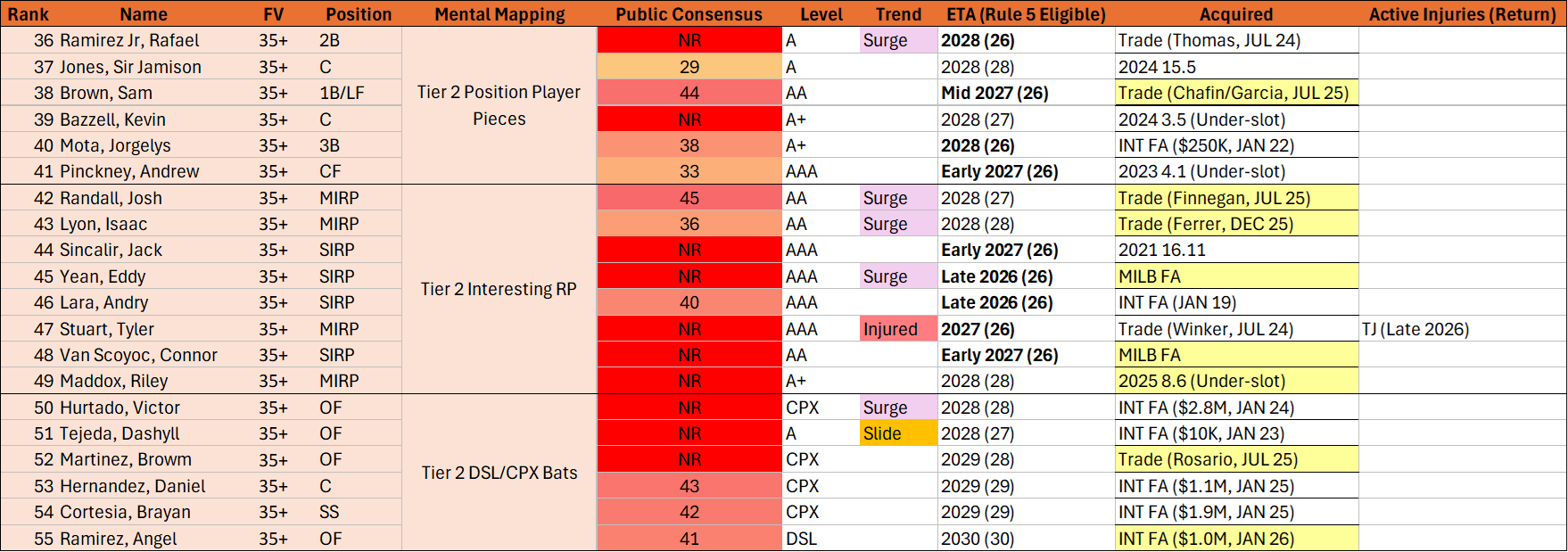
35+ FV players are still worth mentioning, though many would fit into an honorable mention section in a less comprehensive system review. A few will climb into higher tiers in future updates, but for now they remain names to know.
Tier 2 Position Player Contributers
Rafael Ramirez Jr. is a 20-year-old, power-over-hit middle infielder acquired alongside Alex Clemmey in the Lane Thomas trade. He is repeating Single-A for a third straight season, but like many players in the system has reduced his swing rate and is pulling the ball nearly 50% of the time. Jorgelys Mota fits a similar mold, though from the right side and at third base. Mota opened the season in High-A before quickly landing on the injured list.
Sir Jamison Jones and Kevin Bazzell may be the most different pair of catchers in the system. Jones has enough raw power to profile as a backup catcher, but he is striking out more than 30% of the time in Single-A. Bazzell has shown 20-grade game power since draft day, but is finally producing offensively in High-A as a 23-year-old.
Sam Brown and Andrew Pinckney are both close to the majors and project as plausible bench contributors. Brown’s strikeout rate has climbed this season, but he still profiles as an OBP-oriented left-handed corner outfielder. Pinckney is a plus-plus athlete capable of handling center field. He has swung and missed too much this season, but his power-speed combination keeps him firmly in the fourth-outfielder conversation.
Tier 2 Interesting RP
Josh Randall and Isaac Lyon, both right-handed pitchers acquired by trade within the last year, climbed to Double-A after strong starts to their season in High-A. Both are strike throwers who rely more on command and pitchability than pure stuff. Riley Maddox has a bit more velocity, sitting mid-90s early in games, and a whiff-heavy slider. He appears likely to join them in Double-A later this season.
Jack Sinclar, Andry Lara, and Eddy Yean are all right-handed pitchers with fastballs that can touch the upper-90s in short bursts. Sinclair is the most interesting of the group and could develop into a quality middle reliever if he throws enough strikes.
Tyler Stuart, acquired from the Mets for Jesse Winker, has struggled with injuries since his move to the Nationals organization. He is currently rehabbing from Tommy John surgery, though at his peak he looked capable of filling a back-end rotation role. More likely, Stuart settles into a swingman role, where shorter outings could help him recapture some of the upper-90s velocity he showed earlier in his career.
Connor Van Scoyoc, a minor league free-agent signing from Colorado, has quietly pitched well this season outside of a rough outing in his most recent appearance. He comes from a baseball family: his father, Aaron, and a great uncle played professionally, while his brother Spencer pitches in the Phillies system.
Tier 2 DSL/CPX Bats
Victor Hurtado, Daniel Hernandez, and Brayan Cortesia are all large-bonus international signings who have climbed from the DSL to the complex this season. Hurtado, who has received the most attention of this trio, started off red hot but has not appeared in a game since May 21st. If healthy, he remains the most likely of the group to climb quickly. Angel Ramirez rounds out the trio of larger-bonus outfielders in the Nationals' 2026 international class, joining Serrano and Suarez.
Dashyll Tejeda and Browm Martinez were both small bonus international signings who have performed early in their careers. Tejeda, one of my favorite skills-first players in the Nats system, recently made the jump to full-season ball, can absolutely fly, and has a chance to stick in center field. He reminds me of a Jacob Young-esque climber.
Have you really read this far?
According to Substacks’ post info, this post is more than seven-thousand words and would take thirty-four minutes to read. While it took much longer than that to write, I’ve enjoyed the process of diving into the system. Recently a Davy Andrews (Great Writer) article referenced a Sam Miller (Great Writer) quote that spoke to this process:
The explicit goal of that article, and probably the implicit goal of most of my articles, is to give myself/you a reason to pay attention to things so that we can grow to care for them. Not attending to things is how our lives get cluttered with useless garbage.
I can acknowledge this piece is, at times, closer to clutter, though hopefully of the good variety.
Exceptional clutter George. Another fine analysis. It will be interesting to see if Kent does come up after the All Star break. I've seen Lomivita watching on the Bally app. He's been called for catchers interference 3 or 4 times this year which I find concerning. Fitz-Gerald seems like a real gamer, perhaps up to Harrisburg shortly?