

Welcome to the fourth installment of my ordinal and Future Value (FV) rankings of the Nationals system. For brevity in a 10,000-word article, I’ll leave an explanation of FV grades and the chart below to the previous edition. While I would love for you to read the entire piece, if you are instead looking for commentary on a specific player, I’d suggest you use the sliding table of contents on the left side of the screen. Every player is also mentioned by name if you are a fan of CTRL-F.
As I wrote in my draft recap, while individual players may fail for unpredictable reasons, I have become increasingly confident in the Nats’ player development apparatus over the last year. An emphasis on Development Through Data now permeates nearly everything the Nationals do. One benefit of using FV is that it allows us to evaluate the system quantitatively. By this model, the Nationals’ farm system is worth a smudge more than $500 million, which would rank it among the best five or so systems in baseball.
Evaluation Process Changes
I have made several changes to this list since May’s installment. Many of them are player-specific, but there are two broad shifts you might notice.
I’ve put more effort into being deliberate about realizing what I don’t know. I reached out to internal and external sources to receive feedback and metrics, watched more film, and worked with more granular data. FV is designed to tie prospect grades to projected surplus value, with substantial research supporting this connection. To increase rigor, I analyzed my grade density relative to historically comparable farm systems. To spare you a chunk of math, the data showed I probably placed too many players in the lower to middle FV grades. Because of this, some changes should be viewed as recalibration rather than a pure downgrade. Ideally, this more deliberate process will yield better and more independent results.
The second major change is based on a broader trend in the lower minors this season. Baseball America laid out the data earlier this year, but the short version is that minor league power numbers are inflated due to changes in the run-scoring environment compared to previous seasons. The offensive increase is relevant when discussing bat control hitters showing power spikes this season, with Devin Fitz-Gerald among them. As I’m still getting a handle on the data, I’ve decided to be a bit more cautious about several players’ future power output until we better understand the shifting environment.
Washington Nationals Ranked Prospects
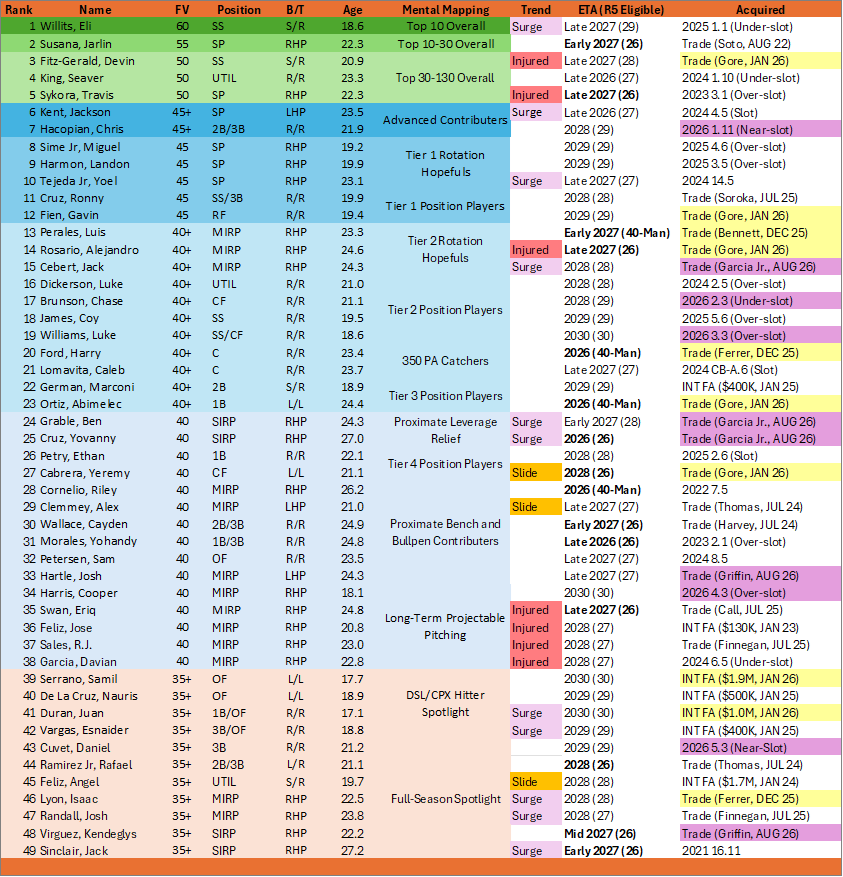
60 FV
Players within this tier are expected to compete for multiple All Star appearances and rank among the top 15 prospects in baseball.
Eli Willits | 60 FV, SS, S/R | ETA: Late 2027
Much of Willits’ evaluation reminds me of similar work on Francisco Lindor before his 2015 debut in Cleveland. A sure fire switch-hitting teenage shortstop, Willits profiles as a prototypical leadoff hitter whose ability to access power will define his ceiling. Willits shows plus zone contact rates paired with elite swing decisions, walking more than he’s struck out since his promotion to High-A. He is hitting the ball in the air more now than he did as a prep bat and can get to pull-side power. As a teenage draftee, his exit velocities were modest but interesting. This season, they’ve jumped multiple clicks (89 average, 110 max) and are already at the major league average, a feat for someone who was supposed to graduate high school this spring. Willits is a plus defender at SS and should rank in the upper third of major league starters there. Willits seems increasingly likely to develop into an above-average hitter while providing plus value as both a baserunner and defensive shortstop. That’s a star-level projection, worthy of a top 10 prospect in the sport.
55 FV
Players within this tier are expected to be core pieces of competitive teams. They will typically rank between 15th and 30th on league-wide prospects lists.
Jarlin Susana | 55 FV, RHP | ETA: Early 2027
Susana recovered from a midseason Grade 1 UCL sprain and returned to Double-A before being shut down last September with a right lat tear. Susana has recently resumed throwing and seems primed to see games in September. The concerns about the fastball shape are overblown, reminiscent of pre-draft worries about Paul Skenes. The pitch, which sits above 100 mph and has topped 103, projects as a plus offering on velocity alone. His slider is his best pitch and one of the best pitches in the minor leagues when he’s on, while his changeup had begun to stabilize before he got hurt. As he matures, I imagine the breaking ball will evolve into two distinct shapes. However, there’s enough here to envision a good outcome where he works primarily with two pitches in his first few seasons. The walks will always be a part of the profile, and where the rate settles will clarify his ceiling. Unless he proves otherwise, Susana should remain in the rotation, where he profiles as a high-variance number two starter, though likely limited to shorter outings driven by high-pitch counts.
50 FV
Players in this tier often rank within the top half of their position in the majors and appear toward the back end of public top 100 lists.
Devin Fitz-Gerald | 50 FV, SS/3B, S/R | ETA: Late 2027
An early-season breakout, Fitz-Gerald’s production tumbled after a promotion to AA. Fitz-Gerald is a compact switch-hitter who can play shortstop, though he might be pushed to third by a rangier athlete. His swing is smoother from the left side, and he sports a sizeable platoon split. Fitz-Gerald looks his best when back-spinning balls to the pull side. Sustaining that against velocity will define his power output as he advances. In AA, Fitz-Gerald has swung too often and rarely waits for pitches he can turn on in the air. While his power numbers impressed in High-A, his exit velocities are closer to average, suggesting a hitter who could settle into less impressive power numbers than his performance might suggest. Fitz-Gerald’s best-case is a switch-hitting middle-infield version of Isaac Paredes, whose extreme batted-ball profile and pitch selection allow his bat control to produce plus slugging. His time in AA has shown his downside, resembling a version of Keibert Ruiz who also strikes out at an above-average rate.
Seaver King | 50 FV, UTIL, R/R | ETA: Early 2027
King is a plus-plus athlete who is held back by aggressive swing decisions, a poor batted-ball profile, and defensive inconsistency. King hits the ball hard, though often on the ground, and shows plus bat-to-ball skills but sometimes trades quality of contact for frequency of contact. King sprays fastballs to the opposite field and very rarely pulls the ball in the air. He has the arm and athleticism to be plus at shortstop eventually, but has struggled with miscues, with lapses reminiscent of CJ Abrams. I expect King to see time throughout the infield, with enough speed and athleticism to handle center if needed. I’ve gone from one of the lower evaluators on King to one of the more optimistic about his long-term outlook. That partly comes from my belief that this staff is positioned to maximize King’s skill set. The emphasis on swing decisions and pulled fly balls could allow his plus athleticism to translate to the majors. King is poised to compete for a starting middle-infield spot in the majors sometime in 2027.
Travis Sykora | 50 FV, RHP | ETA: Late 2027
Sykora has dominated at every stop in pro ball, posting an elite K-BB rate while climbing to Double-A last season. Sykora already possesses velocity and fastball shape, alongside a splitter and slider that both project as plus offerings. Despite an unconventional delivery and relative lack of pro experience, Sykora posted impressive walk rates and looks capable of developing plus command. After undergoing Tommy John surgery last August, he has resumed throwing at the Nats Complex in West Palm Beach, though he seems far away from facing live hitters. Sykora is Rule 5 eligible this offseason, along with Susana and Rosario, and might need to be added to the 40-man roster to avoid a team stealing him to rehab and stash in a major league bullpen in 2027. This could complicate the timeline, as all three balance working their way back from injury with crowding the 40-man roster. This more conservative ranking is primarily a hedge against the uncertainty surrounding his recovery. If Sykora were healthy, I’d be comfortable ranking him among the 10 best pitching prospects in baseball.
45+ FV
Players in this tier represent meaningful proximity, confidence, or upside compared to others in the 45 FV tier, but would not typically rank on public top-100 lists.
Jackson Kent | 45+ FV, LHP | ETA: Late 2026
Kent, a lefty reminiscent of Jake Bennett, throws strikes, works quickly, and locates well enough with two strikes to generate above-average strikeout rates. Kent has shown improved velocity on his fastball (92-94, T96), which plays up because of his plus extension. His changeup is already a superlative offering, approaching a 40% whiff rate and generating more than 60% ground balls in AAA. He locates it effectively to the arm side, often turning to it while ahead in the count. Kent also shows two breaking-ball shapes: a show-me curve and a harder slider. He throws the slider nearly 50% of the time against LHH and regularly locates it to the glove side. His delivery remains somewhat unorthodox, but Kent has continued to limit walks against advanced hitters. If he can sustain this velocity, Kent will position himself as the best healthy pitching prospect in the Nationals system. Kent could reach the majors soon and already looks capable of holding down a mid to back of the rotation spot for the next several seasons.
Chris Hacopian | 45+ FV, 2B/3B, R/R | ETA: 2028
Hacopian is an exceptionally advanced bat who, for the moment, lacks a clear defensive home. At Texas A&M, Hacopian walked more than he struck out, posted elite in-zone contact rates, and consistently produced high-end exit velocities. He hits the ball on the ground too often, but I expect this group to try to coax some PullAir% out of him. Hacopian is sure-handed and has the actions and arm to play on the left side of the infield, but lacks the lateral range to handle shortstop the way he did at Maryland as an underclassman. Some evaluators see him as a laterally challenged second baseman resembling Daniel Murphy or Keston Hiura, but he played third on the Cape and seems capable of growing into the hot corner. Hacopian played with a back injury this spring that often limited him to starting at DH. I expect the Nationals to give him every opportunity to stick at third, but ultimately I think the bat will carry the profile regardless of where he settles defensively.
45 FV
Best utilized as contributors rather than centerpieces, these players fill the strong side of platoons, the back of rotations, and high-leverage relief roles. Some players in this tier possess significant upside, but enough questions remain to keep them below a 50 FV evaluation.
Miguel Sime Jr. | 45 FV, RHP | ETA: 2029
Writing an evaluation of Sime Jr. reminds me of discussing Jarlin Susana in the year following the Juan Soto trade. He throws hard, often sitting above 100 mph throughout outings that currently last only four or so innings. Despite its velocity, the fastball may be his third-best offering, as a whiff-inducing gyro slider and hammer curve can leave hitters helpless. Sime Jr. can look unhittable for an inning before completely losing the strike zone the next. Everything about his profile screams reliever: devastating stuff, a difficult-to-replicate delivery, and an inability to consistently throw strikes. On the other hand, he’s still only 19 and already in High-A. Similar to Susana in the second half of 2024, sometimes everything clicks for young pitchers with this kind of talent. Few pitchers in the minors possess Sime Jr.’s upside, and his development may become a defining test case for the organization’s new pitching infrastructure.
Landon Harmon | 45 FV, RHP | ETA: 2029
Harmon, who began the year in A-ball alongside Sime Jr., received a significant portion of the Nationals’ excess bonus pool from the under-slot Willits deal, effectively signing for late first-round money. Harmon looks every bit the part of a long-term starter. He sits in the mid-90s with a fastball that features natural cut and can generate plus spin. He consistently can land a plus vertical breaking ball in the zone for strikes and will likely have two above-average breaking balls at maturity. At a lanky 6’5”, Harmon already has a prototypical starter’s frame and has room to grow into additional velocity as he adds strength. Harmon is only 19 and is just returning from an oblique injury that landed him on the injured list, but he appears on track to move quickly through the Nationals’ system once healthy.
Yoel Tejeda Jr. | 45 FV, RHP | ETA: Late 2027
A mountain on the mound, Tejeda is the highest up-arrow prospect in the Nats system. He worked out of the bullpen at Florida and Florida State, making him a slower-burn developmental arm as he builds innings and experience. After a velocity dip in 2025, Tejeda has returned to the mid-90s (92-96, T98) while continuing the command gains he made last season. He can reach back for 96s and 97s deep into starts, lending credence to an SP projection. Aided by his height, he reaches elite extension, over 7.5 feet, which helps the velocity play up. Against right-handed hitters, he works mostly east-west using a sinker and a horizontal breaking ball. He’ll throw the sinker with plus run in on the hands, and the horizontal breaking ball both to the arm side of the plate to freeze hitters and low and away to induce chase. Against lefties, Tejeda tries to work elevated fastballs, often attacking with a hard cutter at the hands and off-speed low. Tejeda shows the ability to manipulate his breaking ball shapes, though they can blend later in starts. He also occasionally overthrows one, spiking it to the glove side. The off-speed flashes above-average, though he seems most comfortable with it ahead in the count. Tejeda could reach 120 innings this year and end the season knocking on the door of AAA. This leaves him primed for a late 2027 or early 2028 debut, where he profiles as a durable 2 WAR SP, with the potential for more if his command continues to improve.
Ronny Cruz | 45 FV, SS, R/R | ETA: 2028
Cruz is a precocious rotator capable of generating impressive power for someone of his stature. His swing is a full production, featuring a high leg kick followed by an aggressive rotation designed to crush low-and-inside pitches to the pull side. When synced up, Cruz looks like a special hitter, but he often appears to be committing before recognizing breaking balls. Since his promotion to High-A, Cruz has swung at everything, posting a swing rate higher than most you see in professional baseball. He has chased too often and posted below-average in-zone contact rates. It’s a volatile profile, capable of producing both explosive hot streaks and prolonged cold stretches. Cruz is a smooth defender, though his frame suggests he might move off shortstop as he fills out. Either way, I expect him to remain on the dirt and project as a plus defender. I'm hesitant until I see the offensive approach hold up over longer stretches against advanced pitching, though a Javier Báez-style peak remains within his 99th-percentile outcome. Few hitters in this system have the upside of a Cruz who figures out when to swing.
Gavin Fien | 45 FV, RF, R/R | ETA: 2029
After a slow start following an early-season injury, Fien heated up in June and July. He stands quite upright in the box, slightly closed off from the pitcher, seemingly daring them to test him inside. His offensive approach appears suited to punish the modern game’s emphasis on elevated fastballs. Fien can flatten his bat on pitches up in the zone and hit them with authority. He looks to pull the ball in the air and often does so successfully, showing the ability to translate his raw power into games. Fien posts good zone contact rates, though his swing-decision profile is unusual. He swings at fewer than 60% of pitches in the zone, a rate in the 18th percentile, and often doesn’t offer at pitches below the belt until he gets to two strikes. Despite that passivity, his chase rate remains above average. While this is working for now, pitchers who can consistently land breaking balls low in the zone might give him fits. Drafted as a shortstop, Fien has exclusively played in the outfield this season. He has a plus arm, and I think he'll ultimately become an above-average defender in right. I remain cautious, but it's easy to understand why some evaluators are believers.
40+ FV
I expect these players to reach and stick in the majors, though primarily in complementary roles on the roster.
Luis Perales | 40+ FV, RHP | ETA: Late 2026
Perales, acquired in the Jake Bennett trade, has drawn the frustration of fans watching Bennett succeed in Boston. Perales was always seen as a more volatile pitcher, with an electric high-slot fastball that can touch the upper-90s and a splitter that generates nearly a 45% whiff rate. He also sports a hard cutter and a softer slider, both of which have backed up a bit this season. The cutter can run into the mid-90s, but is carrying significantly more backspin than last year, reducing its vertical separation from the fastball. It has been hit hard this year, accounting for much of the damage against him. The slider has an appealing shape and is a possible future weapon against RHH, but Perales leaves it up and over the plate too often. Perales changed course in July and began throwing his splitter nearly 50% of the time regardless of the hitter’s handedness. He also showed increased extension, especially when throwing his splitter, and was better able to locate it below the zone. There is some precedent at the major league level for splitter-dominant starting pitchers, but not to this degree. I increasingly believe Perales is more likely to settle into a late-inning leverage relief role similar to Fernando Cruz’s unless he begins locating his breaking balls and fastball more consistently.
Alejandro Rosario | 40+ FV, RHP | ETA: Late 2027
On talent alone, Rosario could arguably belong alongside the pitchers at the top of this list. Much of Rosario's scouting report mirrors Sykora's: dominant K-BB numbers, a plus fastball-slider-splitter combination, and questions surrounding the injury recovery timeline. His delivery appears repeatable, and his vertical release characteristics allow the fastball to play especially well at the top of the zone. By the end of 2024, it felt like only a matter of time before Rosario emerged as one of the five best pitching prospects in baseball. Unfortunately, he never pitched in 2025 due to an undisclosed personal health issue, then underwent Tommy John surgery this spring, sidelining him until 2027. When he returns in 2027, Rosario will be 25 years old, Rule 5 eligible, and still sitting on just 88.1 professional innings, all of which came below Double-A. This is an incredibly difficult profile to evaluate as Rosario might still be a top-50 prospect in baseball on pure talent. But the Rangers were willing to include him in a five-player package in which he was not the clear headliner, underscoring just how much risk evaluators attach to the profile. Next season will be a big one for Rosario, as the pressure for him to climb the minor league ladder and recover from his injuries will be immense.
Jack Cebert | 40+ FV, RHP | ETA: 2028
Acquired in the Luis Garcia Jr. trade, Cebert was a late-round pick in 2025 who has quickly climbed to Double-A after adding fastball velocity. Cebert’s fastball has taken a big step up from Texas Tech, sitting closer to the mid-90s with arm-side run (94-96, T98). He can sink, cut, or backspin his fastball, though none of the movement profiles are particularly plus and he too often leaves it over the heart of the plate. His best breaking ball is a mid-80s sweeper with plus horizontal movement and spin, generating above-average miss in-zone and chase. He has also mixed in a below-average changeup occasionally to left-handed hitters. While Cebert has plus walk and zone rates, a lot of his stuff is left over the heart of the zone, and more advanced hitters will punish these mistakes consistently. This has already begun to become a problem in Double-A, as his home run rate has ballooned since his promotion. If he can improve his fastball command or develop another reliable weapon against left-handed hitters, there are enough ingredients for him to stick as a back-end starter. Otherwise, his fastball velocity and sweeper give him a realistic path to a significant bullpen role.
Luke Dickerson | 40+ FV, UTIL, R/R | ETA: 2028
A long-time favorite of mine in this system, Dickerson is a short-levered compact infielder with concerning bat-to-ball metrics. He is a powerful athlete with plus bat speed and runs well enough to fit in center. Dickerson is patient, running swing rates below 40%, and produces both walks and strikeouts as he works deep counts. Dickerson punishes anything slow inside, routinely launching it to the pull-side with authority. His sub-80% zone contact rate is below average. He is sometimes late on fastballs despite his short levers and simple load, suggesting the issue is pitch recognition or ability to trigger, not bat speed. When Dickerson is going well, he is religiously particular about swing decisions. When he’s pressing, he expands his go-zone and pays for it. Until he can protect a larger sliver of the plate, I worry that advanced pitchers will exploit his passivity. Defensively, he likely no longer fits at shortstop but has seen time at second base, third base, and center field this year. Dickerson profiles as a power-over-hit utility player whose ceiling will ultimately depend on whether he can trim the swing-and-miss enough to handle an everyday role.
Chase Brunson | 40+ FV, CF, R/R | ETA: 2028
Brunson, the Nats’ second-round pick, was a player who I thought might profile as an under-slot option at 11 overall. Brunson hits the ball hard, often in the air to the pull side, and makes solid swing decisions. He posted above-average zone contact rates in college and shows above-average straight-line speed. Brunson profiles well in center, though a more rangy or acrobatic athlete would probably push him to a corner. For now, Brunson earns this ranking because I trust the stability of both his bat and glove more than is typical for a recent draftee. At the same time, his tools are not particularly flashy, and his ceiling is likely lower than that of several prospects ranked below him.
Coy James | 40+ FV, SS, R/R | ETA: 2029
James is a flashy athlete with legitimate speed-and-power upside and the defensive tools to remain on the left side of the infield. The upside is difficult to ignore, but James has struggled against breaking balls early in pro ball after the Nationals aggressively assigned him to full-season ball to open the year. When James does connect, he can drive the ball with authority to all fields. Partly due to the crowded Single-A shortstop picture, James has seen time across the infield. His actions and feel for shortstop are raw at times, as he still seems to be trying to catch up to pro speeds. He also has seen some time in left field, where his reads and instincts remain similarly unrefined. James is still one of the most exciting athletes in the system, but his first full professional season has done little to clarify how high his ceiling or floor ultimately are.
Luke Williams | 40+ FV, SS/CF, R/R | ETA: 2030
Williams, the Nats’ third-round pick, is one of the most volatile hitters I’ve tried to rank. Like many prep hitters, Williams is difficult to evaluate because my own viewings are limited and much of the public information comes from third-party reports. Complicating matters further, Williams missed most of the Summer Circuit with an ankle injury, limiting opportunities to evaluate him against elite peers. Everything you hear about Williams includes one word: explosive. Williams has plus-plus speed, a plus-plus arm, and legitimate raw power. At the Draft combine, Williams hit a ball 108 mph, a near major league-average max exit velocity, and tested well in various events measuring athletic power. As is common with non-first-round prep hitters, there are significant questions about the hit tool, exacerbated by the missed time. Williams plays both shortstop and center, but I cannot confidently say which position the Nats will focus on. He'll be one of the most important players to follow next spring.
Harry Ford | 40+ FV, C, R/R | ETA: 2026
Ford’s value is driven more by his plate discipline and on-base ability than by impact contact. He has struggled this season, dealing with a reported shoulder injury that has coincided with a significant decline in his power metrics. His approach seems to have come around in June and July, as he slashed his chase rates, but he continues to struggle to impact the baseball consistently. I worry that major league pitchers will increasingly challenge him in the zone. If Ford cannot consistently punish mistakes, his on-base ability becomes less valuable as pitchers feel more comfortable attacking him. While Ford has never been a poor defender, continued offensive regression would place increasing pressure on his glove to develop into true starter quality. If Ford can’t return to closer-to-average exit velocities, he seems likely to fall short of prior expectations, increasingly looking more like an interesting part of a catching tandem than a potential All Star.
Caleb Lomavita | 40+ FV, C, R/R | ETA: Late 2027
Lomavita shares many of the same traits as Seaver King, fitting given he was selected just 29 picks after him. He hits the ball hard on the ground, swings and chases excessively, and inconsistently applies his elite athleticism at a premium position. Lomavita generates above-average raw power with an aggressive lower-half operation, though he often overcommits against breaking balls out of the zone. He has above-average in-zone contact rates and can pull the ball with authority. Defensively, Lomavita has struggled more than early evaluations suggested. His throwing accuracy has been inconsistent, with routine sails and skips into center field, and his receiving often appears abrupt or uncertain. Lomavita is a fantastic athlete, and this coaching group has shown an ability to develop catcher defense at the major league level. Whether those gains extend throughout the player-development system remains to be seen. Bluntly, developing catcher defense was not a strength of the old organization, and I wonder whether Lomavita’s poor habits will take time to break. I still believe there's a path to an above-average defensive catcher whose bat allows him to carve out a meaningful major league role.
Marconi German | 40+ FV, 2B, S/R | ETA: 2029
German is a switch-hitting, undersized middle infielder who flashed in the DSL as a 17-year-old in 2025. On the complex this season, German has made loud contact for a teenager (87.5 avg EV, 101 EV90), especially from the left side. His 77% zone-contact rate and 35% chase rate suggest a hitter who is still growing comfortable with pitch recognition and swing decisions. After walking more than he struck out in the DSL, those rates have flipped ever so slightly this season. German is still spindly, and his frame suggests a limited ability to put on significant muscle mass without moving away from the middle of the infield. Still, I think there is a Goldilocks zone where German stays nimble enough to play second base and develops into an OBP-driven utility player with league-average power from both sides.
Abimelec Ortiz | 40+ FV, 1B, L/L | ETA: 2026
Ortiz, measuring at 5’10” and 230 pounds, can absolutely mash. His max exit velocity, 116.3 mph, would put him in the 99th percentile of major leaguers this season, sandwiched between James Wood and Aaron Judge. In AAA, he has hit both four-seam fastballs and breaking balls well, with most of his damage coming to the pull side. He puts the ball in play more than most sluggers of his ilk and projects for lower-than-typical strikeout and walk rates in the majors. That same aggression also drags his average exit velocity closer to plus than elite, as he frequently swings at pitches he cannot drive. Ortiz is not fleet-footed and can struggle to take an extra base on hard-hit balls to the outfield. He has seen time in the corner outfield this season, but he fits best as a first baseman whose frame will likely limit him to below-average defense there. Ortiz lacks the combination of game power and on-base ability typically required of an everyday first baseman or designated hitter. Instead, Ortiz would be best served in a part-time role, where he could have multiple 15-home-run, low OBP, 350-plate-appearance seasons.
40 FV
40 FV players play a vital role in an organization. They are projected to make major league rosters, though more often on the fringes, and their lack of proximity or star-level upside holds them back from higher tiers.
Ben Grable | 40 FV, RHP | ETA: Mid 2027
Ben Grable is my highest-ranked relief-only prospect, wielding a 70-grade fastball that rivals the best in the Nats system. Grable hides the baseball behind his head, drives to plus extension, and whips it from a low release point despite his higher-than-average arm slot. Those release traits generate exceptional backspin and a flat vertical approach angle, allowing his upper-90s fastball to miss bats in the zone at plus-plus rates, 35% so far this season in Double-A. To put that in perspective, only Mason Miller, Jhoan Duran, and Jacob Misiorowski own higher major-league fastball in-zone whiff rates this season. Grable has an average slider and has experimented with a splitter this season in hopes of developing a reliable second pitch. Grable pounds the zone because hitters rarely touch him and his fastball command approaches plus. If Grable can develop a usable second pitch, which seems likely given he’s only had one pro offseason, he would profile as a high-impact leverage reliever similar to a right-handed Sean Doolittle, whose role on the Nationals coaching staff could make him an ideal mentor.
Yovanny Cruz | 40 FV, RHP | ETA: 2026
Cruz is a flamethrowing right-handed relief pitcher acquired from the Yankees as part of the Luis Garcia Jr. trade. Cruz is a high-upside relief-only prospect, with a triple-digit fastball that is his third-best pitch due to sub-optimal shape. His gyro slider is filthy, running whiff rates close to 50% in AAA this season despite often unintentionally spinning it into the top of the zone. His splitter can flash plus-plus, though he throws it sparingly and has struggled to locate it. His control remains inconsistent, but he attacks hitters aggressively enough to keep his walk rates around league average. Cruz could be a truly dominant reliever if he can better harness his off-speed, though he profiles as a leverage arm regardless.
Ethan Petry | 40 FV, 1B, R/R | ETA: 2028
After an early-season breakout, Petry has struggled since his promotion to Double-A. While his raw power is comfortably plus-plus, lingering whiff concerns could limit how consistently that power translates against advanced pitching. Petry absolutely demolished the Cape before his draft year, launching 11 home runs while posting a 1.235 OPS across 32 games. That stretch remains one of the better demonstrations of how impactful his raw power can be when he is consistently getting the barrel to the baseball. Petry’s ISO declined each season after his monster first year at South Carolina, though he also trimmed his strikeout rate to 17% during his draft season before suffering a shoulder injury. In AA, he has posted below-average whiff and zone-contact rates and has chased too often. Petry has looked surprisingly passable in some time in the outfield this season, but likely profiles at first in the majors. He still has enough power to carve out a major league role, but I remain skeptical that he'll hit enough to profile as an everyday right-handed hitting first baseman.
Yeremy Cabrera | 40 FV, CF, R/R | ETA: 2028
Cabrera, the fourth player acquired in the MacKenzie Gore trade to appear on this list, also saw his hot start cool after a promotion to High-A Wilmington. Cabrera clearly understands modern hitting philosophy, and his swing is aggressively designed to generate lifted contact to the pull side. His dominance in A-ball was fueled in part by a vicious 30% PullAir% alongside dramatically improved chase rates. Despite maintaining nearly identical in-zone contact after the promotion, Cabrera’s chase rate has climbed back to an unpalatable 31%, leading to more strikeouts and fewer walks. Cabrera struggles against breaking balls and, like several players on this list, has run into trouble against more advanced pitchers capable of consistently locating them within the strike zone. Cabrera not only looks capable of handling center field, but could ultimately profile as a plus defender there. Right now, this looks like the profile of an interesting power-over-hit fourth or fifth outfielder, though solving the breaking-ball issue could allow Cabrera to develop into something more substantial.
Riley Cornelio | 40 FV, RHP | ETA: 2026
Cornelio sat around 97 mph in spring training, roughly two ticks higher than he averaged as a starter in 2025, opening eyes in an organization desperate for pitching depth. That velocity has since settled slightly, though his four-seam fastball still has significant horizontal run. Cornelio features a gyro slider, which has generated a plus-plus 60% whiff rate in Triple-A this year. He has also experimented with a splitter that flashes plus potential, though it still misses arm-side and up too frequently to function as a weapon consistently. His lack of a true off-speed pitch has allowed hitters to sit on the fastball and punish mistakes. Cornelio would need better command and an off-speed pitch to take leverage innings in the majors, and developing both could eat heavily into his remaining option years. More likely, he settles into a multi-inning bullpen role where he can be deployed more selectively against right-handed hitters while potentially climbing back into the upper 90s in shorter bursts.
Alex Clemmey | 40 FV, LHP | ETA: Late 2027
Clemmey posted elite strikeout rates (>30%) in High-A before making the jump to Double-A, driven largely by a rising fastball and inconsistent breaking ball. As a teenager, Clemmey’s 6’6”, 205-pound frame convinced me his velocity would eventually climb into the upper 90s. Instead, three years into pro ball, his fastball still sits 93–95, though it features enough ride to play at the top of the zone. His gyro slider can generate real swing-and-miss, and his changeup has taken a step forward this season, though he still occasionally loses feel for it entirely. Clemmey has time on his side: he is in Double-A at just 20 years old and will not be Rule 5 eligible until December 2027. I expect the Nationals to continue developing him as a starter, though his lack of a truly dominant offering and elevated walk rates likely cap him as a back-end rotation arm. Long-term, he may fit better in the bullpen, where a few extra ticks of velocity could turn him into an intriguing leverage reliever.
Cayden Wallace | 40 FV, UTIL, R/R | ETA: Early 2027
Wallace, acquired in the Hunter Harvey trade that also brought over the Comp A pick used on Caleb Lomavita, has reemerged this season after a difficult start to his Nationals tenure. His step forward largely owes to plus swing decisions and a commitment to accessing pull-side power. His exit velocities are closer to average than plus, but he’s shown the ability to hit 15 bombs a year in a full-time role. He loves to swing, and, despite his strong swing decisions, will run below average walk rates. Wallace has played second, third, and shortstop this season, the rare climber up the defensive spectrum. He likely has enough athleticism to handle corner-outfield work as well, which would only strengthen his profile. Wallace profiles as a fringe Rule 5 candidate entering the offseason and could become a late 40-man roster addition if the organization views him as a viable major league depth piece.
Yohandy Morales | 40 FV, 1B, R/R | ETA: Late 2026
Morales is another bounce-back corner infielder whose Triple-A surface stats might leave some wondering why he is not ranked higher. Morales has always hit the ball hard, and this season has been no exception, as he continues to post plus hard-hit rates and exit velocities. He has increased his pull rate this season, but nearly three-fourths of the balls he hits to the pull side still come on the ground. Morales is often late getting to fastballs and remains prone to both chase and swing-and-miss. His in-zone contact rate hovers around a concerning 74%, a range where even truly elite power hitters struggle to survive offensively. While Morales still profiles best at first base, I have been pleasantly surprised by how sure-handed he has looked at third. I do not believe he will ever become an above-average defender at the hot corner, but I think he could occasionally spell a left-handed-hitting third baseman to gain the platoon advantage. Just before this list was published, Morales was placed on the injured list with an injury, and his return date is unknown.
Sam Petersen | 40 FV, CF, R/R | ETA: Late 2027
Sometimes you have to shrug and admit that good hitters keep hitting. Since his sophomore year of college in 2023, Petersen has posted full-season wRC+ marks of 139, 142, 165 (A/A+), and 125 (Double-A). I was initially hesitant about Petersen. Before Double-A, Petersen routinely faced younger pitching and generally performed the way you would expect an advanced college hitter to perform. This season, Petersen’s strikeout rate has climbed while his contact rate has dipped below 70%. Still, he continues to hit for power, steal bases, and provide acceptable defense in center field. There are enough positive traits here for me to believe Petersen could carve out a role as a fifth outfielder on a major league roster, even if the whiff concerns remain troubling.
Josh Hartle | 40 FV, LHP | ETA: Late 2027
Hartle is a low-slot left-handed starting pitcher who is a small velocity jump away from fourth-starter territory. His fastball sits in the low 90s, though his plus extension and low release allow its angles to play well within the zone. He pairs it with a plus changeup and an average sweeper, giving him weapons against hitters from both sides of the plate. Hartle can occasionally nibble around the zone, but he still posts good walk rates and projects for plus command. He has now pitched at Wake Forest and in the Guardians and Pirates organizations before joining the Nationals—three programs known for their recent success developing pitchers. Whether the Nationals can unlock extra velocity or refine his breaking-ball shape beyond what those organizations could remains to be seen. For now, Hartle fits in the bullpen, where his low slot, strike-throwing ability, and plus changeup could make him an effective middle reliever. If the velocity ticks up or the breaking ball takes a step forward, there is a realistic path to a role in the rotation.
Cooper Harris | 40 FV, RHP | ETA: 2030
Harris is a projectable high school right-hander whose frame, fastball malleability, and spin profile make him an intriguing long-term development project. He throws from a high slot, and his fastball, which currently sits in the low-90s and touches 96, is driven by heavy sink and arm-side run, generating groundballs in bunches. His breaking ball shape is inconsistent, but it shows plus spin rates and enough flashes to work with for a pro dev team. He also flashes an off-speed pitch that he can locate below the zone. As a higher-slot pitcher with what appears to be a natural supination bias, Harris seems like a candidate to lower his slot slightly. Doing so could unlock more horizontal movement on his sinker while allowing his breaking ball to evolve toward a sweeper-like shape. Harris is a long-term developmental bet who should spend much of 2027 on the complex refining his arsenal.
Eriq Swan | 40 FV, RHP | ETA: Late 2027
Swan, acquired from the Dodgers in the Alex Call trade, has a deep repertoire and present velocity. Still, pitch-shape concerns, below-average command, and an extensive injury history leave him projecting as an up-and-down reliever. His fastball is hard, touching triple digits in 2025, but from his high slot and 6-foot-4 frame, the pitch enters on a steep plane with below-average shape, leading to underwhelming results despite its velocity. He sports a hard cutter that got hammered in 2025 and a slider that flashes plus horizontal movement. In limited time this year, Swan has shown an improving off-speed that he shows some feel for. Swan has always run high walk rates, and charting some of his outings leaves a very scattershot pitch diagram. He returned from an early-season injury in June, but appeared to reinjure his pitching arm in a July rehab start. If the Nationals can remap his arm action to help the fastball play more effectively in the zone, the rest of his repertoire could be enough to support a middle-relief role.
Jose Feliz | 40 FV, RHP | ETA: 2028
Before the season, I picked three Nationals pitching prospects to break out: Jackson Kent, Yoel Tejeda Jr., and Jose Feliz. Feliz has low velocity (88-92, T93) but a plus feel for the zone, showing sub-5% walk rates on the complex. He pairs a plus gyro slider with an above-average off-speed offering and rounds out the arsenal with a usable cutter that plays well off the fastball. After a successful 60-inning season on the complex in 2025, Feliz appeared poised for a late promotion before being shut down in August. Feliz then opened 2026 on the 60-day injured list. While the organization has not publicly disclosed the injury, the timing suggests a significant arm injury suffered sometime last fall or winter, robbing him of an important developmental season. There are enough ingredients here that even a modest velocity jump—hardly uncommon for a still-filling-out 20-year-old—could transform Feliz into a legitimate starting pitching prospect.
R.J. Sales | 40 FV, RHP | ETA: 2028
Sales, part of the return in Kyle Finnegan’s trade to Detroit at the deadline, is another low-level performer with an innings floor in the vein of my typical breakout picks. Sales has real velocity, flashing 96s and 97s early in starts, and his stuff took a jump after his move to Fredericksburg. In his six starts following the deadline, his K% jumped to nearly 30%. Both his cutter and slider posted whiff rates higher than 40%, and he demonstrated a show-me curve and change that could provide a starter’s mix if they improve. He suffered what sources call an “Upper Torso injury” to start the season, but, if he returns in similar form, there are a lot of elements (deep mix, plus command, multiple 90+ inning seasons) that interest me as a sleeper going into next season.
Davian Garcia | 40 FV, RHP | ETA: 2028
Garcia earned an aggressive promotion to Double-A this season after adding roughly three ticks of fastball velocity over the offseason. He has two distinct breaking ball shapes and a developing splitter, but has struggled with walks since his pro debut. Garcia exited his May 16 start with an apparent injury and has since been spotted in West Palm Beach with a large arm cast. While the organization has not disclosed a diagnosis, significant arm injuries following abrupt velocity gains are unfortunately not uncommon. Before the injury, Garcia was one of the fastest-rising pitching prospects in the system, and his newfound velocity combined with a starter's repertoire made him an intriguing breakout candidate. That excitement is now on hold until at least 2027, though he'll remain one of the more interesting names to monitor as he works his way back.
35+ FV
The most interesting names in the “Honorable Mention” pool of players.
Samil Serrano | 35+ FV, OF, L/L | ETA: 2030
Serrano, a high-dollar 2026 international signing, is a hit-over-power left-handed outfielder who shows admirable bat-to-ball skills. Serrano consistently squares up the ball, pairing a zone-contact rate north of 90% with an above-average rate of airborne contact. While it is mostly doubles power today, Serrano has already produced several batted balls north of 105 mph in the DSL as a 17-year-old, hinting at considerably more power as he fills out his 6-foot-3 frame. Though initially viewed as less likely to remain in center field than some of his peers in the 2025 class, Serrano has handled the majority of the starts there this season, often ahead of several other capable outfielders. Serrano should be a priority development target this offseason and appears on track to reach the complex next year.
Nauris De La Cruz | 35+ FV, OF, L/L | ETA: 2029
De La Cruz is a sweet-swinging left-handed outfielder with plus bat-to-ball ability and surprising power. He pairs strong in-zone contact with solid swing decisions, and walked nearly twice as often as he struck out in the DSL last year. Despite showing a tendency to elevate the baseball in the DSL, he’s hit more groundballs since coming stateside and is popping up balls at an incredibly high rate. His attack angle appears to flatten at contact, perhaps in part because he is arriving a bit late against improved velocity. His pull rate, north of 50% in the DSL, has also declined significantly, further supporting that explanation. De La Cruz has played a lot of center field this year, but is more likely to end up in a corner. After an encouraging 2025 campaign, De La Cruz appears likely to start again on the complex in early 2027, though he could make the transition to full-season ball as a teenager.
Juan Duran | 35+ FV, 1B/OF, R/R | ETA: 2030
Duran has played most of the 2026 DSL season as a 16-year-old and was billed as a power-over-hit right-handed outfielder but has put up gaudy contact numbers so far. Duran has plus raw power, though like many teenage hitters, he still puts too many balls on the ground. Stout and physically mature for his age, Duran seems less likely than most young-for-class hitters to grow into substantially more power. The biggest question surrounding Duran entering pro ball was always the hit tool. So far, the DSL data suggests that concern may have been overstated. His strikeout rate and zone-contact rates are both plus, suggesting a more advanced hitter than advertised. Duran has played mostly first base this season. However, the Nationals’ DSL outfield is incredibly crowded, meaning the position may simply be a product of roster construction. As a defensively-limited right-handed hitter, the bat must clear a significant bar to continue to rank on prospect lists. Despite being named a 2026 DSL All Star, Duran may still repeat the DSL next season because of his age. If he opens 2027 on the complex as a 17-year-old, however, his stock will rise considerably.
Esnaider Vargas | 35+ FV, 3B/OF, R/R | ETA: 2029
Vargas, who is repeating the DSL as an 18-year-old, has been pushed to the infield by the bevy of outfielders in the Nats’ 2026 international class, but is showing interesting power projection. Vargas appears to have added nearly 15 pounds of muscle over the last year, and it’s reflected in his batted-ball data (87.1 mph average EV, 101 mph EV90). He has a ton of bat speed from the right side and has shown an ability to pull the ball, though mostly on the ground for now. His zone contact rates have jumped up this year (86%), though he swings and chases far too often. He has split time between third and first base after spending most of last year in the outfield, and seems likely to be able to handle third or the corner outfield at maturity. Vargas was a lower-dollar 2025 international signing, but he is emerging as one of my favorite players from that class.
Daniel Cuvet | 35+ FV, 3B, R/R | ETA: 2029
Cuvet is a power-over-hit third baseman taken in the fifth round of the 2026 draft. At points in his college career, Cuvet had an untenable swing and chase rate and expanded the zone wildly, though he walked more than he struck out in his final season at Miami. Despite his newfound patience, Cuvet still missed a considerable number of pitches in-zone. His EVs in college were impressive, with power numbers to show for it. Across 38 games in two summers on the Cape, Cuvet slugged .486, nearly 50% above league average, showing a solid translation of his power tool to a wooden bat league. Depending on how quickly he signs, Cuvet should be pushed to Single-A this fall or to start next year, as he will need to be tested against more advanced pitching. Cuvet profiles as a power-hitting bench bat whose high-strikeout, low-OBP profile holds him back from more consistent playing time.
Rafael Ramirez Jr. | 35+ FV, 3B, L/R | ETA: 2028
Ramirez Jr. is a 20-year-old power-over-hit middle infielder acquired alongside Alex Clemmey in the Lane Thomas trade. He is repeating Single-A after missing most of last year with a series of injuries, but, like many players in the system, has reduced his swing rate and is pulling the ball nearly 50% of the time. Ramirez Jr. has doubled his line-drive rate this season and is making much harder contact, though it remains mostly doubles power for now. While he played a convincing shortstop in Cleveland’s system, Ramirez Jr has played second and third with the Nats, where he could eventually profile as plus. Ramirez Jr has gotten slightly lost in the crowded infield picture in the lower minors, but could fit as a left-handed utility bat.
Angel Feliz | 35+ FV, UTIL, S/R | ETA: 2028
Feliz received an aggressive promotion to High-A as a teenager at the start of the year and has struggled, looking less like the breakout hitter he had been. He posted strong numbers in the DSL in 2024 and opened 2025 in the complex with similar underlying performance, albeit with slightly less power. After taking a step backward in 2025, Feliz has begun pulling the ball more frequently in full-season ball and is hitting fewer groundballs, though still not enough of his contact is elevated. At present, Feliz does not impact the baseball consistently enough, though his frame leaves room for additional strength. Defensively, Feliz has looked better at short this season than last, though I still think his long-term home is more likely to be second or third base. Feliz previously showed swing decisions and a zone contact rate that suggested – with additional muscle mass – he could trade some of that bat-to-ball ability for league-average pull-side power. That future now looks less likely. That said, Feliz is still young enough to make meaningful adjustments and retains the upside of a switch-hitting, multi-positional bench player.
Isaac Lyon | 35+ FV, RHP | ETA: 2028
Lyon, acquired alongside Harry Ford in the Jose Ferrer trade, is a strike-throwing right-hander whose profile could change dramatically with even a modest velocity jump. Lyon attacks the zone, posting plus-plus zone and strike rates in every stop this year. His fastball has continued to struggle against more advanced hitters, and opponents rarely swing and miss against him. He has a breaking ball and changeup that flash average, though he struggles to induce chase. Lyon has many of the traits I look for in pitching breakouts: room for velocity growth, strike-throwing ability, and enough innings to serve as a launching pad going into next season. For now, Lyon profiles as an up-and-down reliever whose strike-throwing ability gives him a relatively high floor, though he'll likely spend plenty of time shuttling between Triple-A and the Majors.
Josh Randall | 35+ FV, RHP | ETA: 2028
Much of what makes Isaac Lyon interesting applies here as well. Randall is a strike-throwing right-hander with a deep repertoire and innings floor who could make a jump with a velocity gain. Randall's aggressiveness in the zone can work against him, as he too often leaves pitches over the heart of the plate and has been punished at times this season. Randall works with an average fastball, breaking ball, and off-speed, with some demonstrated ability to manipulate the breaking ball shape into multiple offerings. Randall is a year further removed from the draft than Lyon, and his low walk rates ride more on aggressiveness and control than true command. Randall offers slightly more raw stuff and slightly less command than Lyon, making him the more interesting bullpen conversion candidate. For now, Randall projects as a depth starter who might click better in the bullpen.
Kendegyls Virguez | 35+ FV, RHP | ETA: Mid 2027
Virguez is a relief-only prospect with a triple-digit fastball and a checkered injury history. Vargas has thrown only 139 innings since 2022, dealing with multiple injuries that have limited his development. Vargas’ fastball has plus arm-side run, generating both misses in-zone due to its velocity and lots of contact on the ground due to its shape. His horizontal breaking ball seems closer to average, though it generates plus chase rates when tunneled with his fastball. Vargas walks too many batters, though a reasonable evaluator might attribute that to his relative lack of experience and innings. A triple-digits fastball no longer buys an automatic spot in the back of a bullpen, but Virguez still profiles as an interesting middle reliever, whose ceiling is defined by his command and breaking ball development.
Jack Sinclair | 35+ FV, RHP | ETA: Early 2027
Sinclair is a pop-up relief prospect whose velocity and breaking ball characteristics make him an intriguing bullpen arm. Sinclair throws from a low right-handed slot, and his sweeper is fantastic, occasionally touching 20 inches of horizontal break and generating both in-zone misses and chase. He pairs his sweeper with a hard fastball (96-98, T99) that he can both backspin and sink, with the sinker showing good run in on the hands of right-handed hitters. Sinclair also has a hard cutter that, at times, looks like his best pitch but is too often left over the middle of the zone. He has also shown a changeup that can generate misses below the zone as a change of pace. Sinclair is scattershot, sometimes alternating between non-competitive misses and pitches left over the heart of the plate, limiting him from higher leverage. The command likely limits his ceiling, but the quality of the arsenal gives him a realistic path to meaningful major league innings.
Honorable Mentions
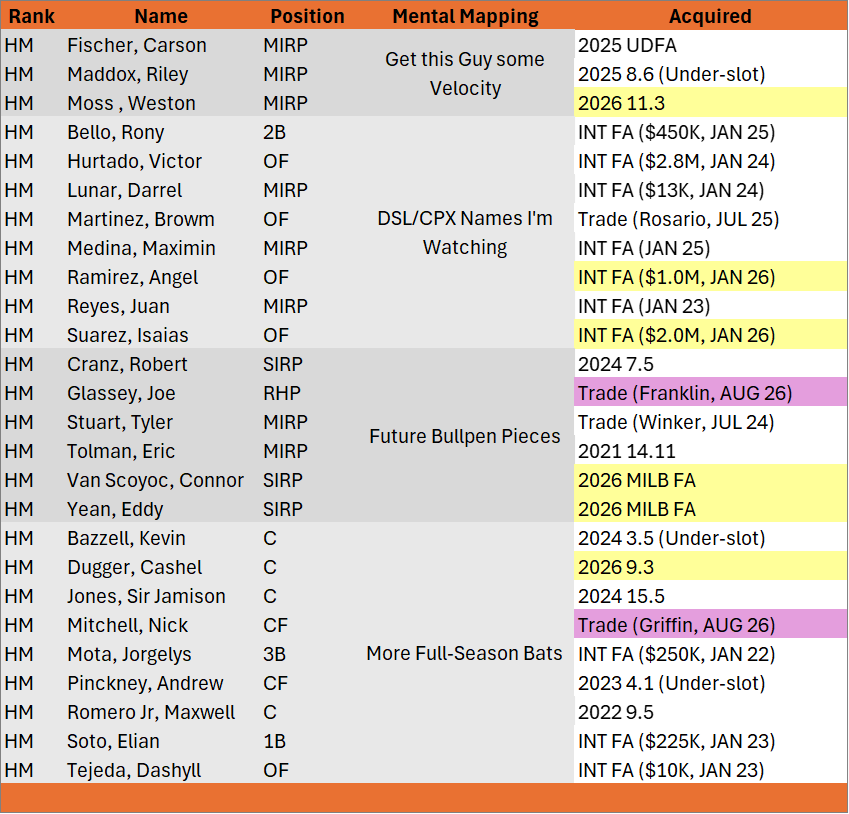
While players in this section are currently below the level I would typically assign an FV grade, they are important names to know to understand the shape of the minor league system. Players who have historically been listed in this section have climbed onto future lists or been part of real trades. These players and groups are in no particular order, though some of them were much closer to being ranked than others.
Get This Guy Some Velocity
Weston Moss, one of my favorite 2026 Nats draft picks, is a low-slot RHP with two interesting breaking ball shapes with plus spin and a low-90s fastball. His off-speed shows promise, but he releases it almost half a foot lower than the rest of his arsenal, allowing hitters to pick it up early. Riley Maddox and Carson Fischer are control-over-stuff right-handed pitchers with deep mixes and the ability to sustain a starter’s workload. If any of these three add velocity, they could follow a Jackson Kent or Yoel Tejeda Jr path and jump up this list.
DSL/CPX names I’m watching
As I discussed nearly 9000 words ago (phew), some of these names might deserve grades as high as 40+ and could be trade targets for an outside org, but I lack the confidence and information to feel comfortable distinguishing between them. Isaias Suarez was a high-bonus hit-over-power outfielder in the Nats’ 2026 class. He makes good contact, and much of it is in the air, and is very patient at the plate. Browm Martinez became a hot name in Nats prospect circles for his surface-level production, but his underlying EVs (82.5 mph average) and Z-contact rates (73%) on the complex are worrying. Victor Hurtado was a big-bonus sweet-swinging lefty outfielder, but his contact metrics look poor enough to wonder if he might stall out in full-season ball. Rony Bello is a shorter right-handed middle infielder who has hit well while repeating the DSL this year, pulling the ball in the air to some success. He is older than the typical DSL bat and should get pushed to the complex to see if the power continues to translate. Angel Ramirez is a switch-hitting outfielder with an enviable ability to pull the ball in the air from both sides of the plate and questionable contact metrics. He seems likely to repeat the DSL in 2027. Darrel Lunar is a projectable RHP with present velocity on the complex, though his fastball shape would likely need continued development to work against advanced hitters. Maximin Medina is a strike-throwing right-hander whose profile could pop quickly if the velocity ticks up. Juan Reyes, who was recently promoted to full-season ball but will remain in this section, is a 21-year-old lefty who succeeded in the DSL and complex, but is a bit behind the age-by-level timeline of a typical young arm.
Future Bullpen Pieces
Robert Cranz has a high IVB fastball that will catch the attention of metric-watchers, but his short extension and high release point produce closer-to-average approach angles, reducing its effectiveness. Joe Glassey has a flat mid-90s fastball, an interesting but inconsistent splitter, and throws lots of strikes. Tyler Stuart, acquired for Jesse Winker in 2024, was once seen as a back-of-the-rotation option and is currently on the road back from TJ. An extra tick of velocity in shorter spurts paired with his control and slider would let him serve a long relief role in a major league bullpen. Eric Tolman is a AAA LHP with a good curveball and haphazard control. In a league perpetually desperate for left-handed relief, he seems likely to get an opportunity if he can trim the walk rate. Connor Van Scoyoc has spent time in both the Angels and Rockies systems—a pair not known for pitching development—and could emerge as a major league reliever with another offseason of development. Eddy Yean is an RHP with a triple-digit fastball that plays down because of its shape, limiting what should otherwise be a premium velocity profile.
More Full-Season Bats
Kevin Bazzell is a catcher whose bat has shined this season, though he is old for the level in High-A and needs to perform against better competition before I believe in the bat again. Cashel Dugger, the Nats 9th-round pick, is a plus defensive catcher with good bat-to-ball metrics. An additional focus by a pro dev team on bat speed development could elevate the bat enough to profile as a major league backup. Sir Jamison Jones is a plus-power catcher with promising defense, though enough hit-tool questions that I’ve cooled on him. Nick Mitchell is a bat-to-ball centerfielder with an OBP-driven profile. Similarly to Dugger, additional bat speed would be required to grow into a bench role. Jorgelys Mota has plus power, speed, and third base defense, but questions about his hit tool have stalled him in the lower minors. Andrew Pinckney and Maxwell Romero Jr have good surface numbers, though their underlying contact and strikeout metrics suggest their offensive profiles may not translate cleanly to the major league level. They profile as fringe 40-man candidates, though further development could allow either to carve out a bench role. Elian Soto has good numbers, enough to be recognized as more than just Juan’s brother, but strikes out more than is comfortable for a player who is likely limited to first base. Dashyll Tejeda is a fleet-footed center fielder with solid OBP skills. He could eventually profile as a fifth outfield option as a defensive replacement or pinch runner.
Have you really read this long?
At more than 10,000 words, I believe this is one of the longer Nats minor league system previews available in the public sphere. This process is enjoyable, informative, and challenging, and I expect the quality (and quantity) of work to reflect the effort I put into it. I remain, as always, interested in defending and discussing my work, either in the comments or on Twitter, where I remain faithfully stuck despite efforts to migrate. If I missed a player that you like while mentioning more than 65 names, you should assume that it is a direct insult and dismissal of your opinion and not a mistake by someone who does this for free. As always, please subscribe.
This is absolutely outstanding work that helps me be a lot more educated about what’s going on in the organization. It’s easy to stay engaged and keep reading even further down in the article - keep doing what you’re doing because this is high quality stuff
All I can say George is I hope someone in the Nats front office is reading your work. This was a joy to read, especially since the big club is in an awful slump right now. It certainly does give hope for the future. It dovetails perfectly with the move to analytics.
Two questions; Do you think we see Perales or Jackson Kent coming up before September, if only for a look see?
And regarding Devin Fitz-Gerald, I'm wondering if his mother's health issues (which I gather the Nats have tried to help on the financial side with) might also be playing into his Double AA problems. It's a lot for a young kid to deal with.